
Project Overview:
This research project examines how equine-assisted therapy is studied and measured in academic research. While many programs report emotional and behavioral benefits, researchers disagree on what counts as valid evidence of improvement. Some studies rely on interviews and lived experience, while others measure stress through biological data like cortisol and heart rate. This paper analyzes that disagreement and argues that horse-based therapy operates on multiple levels that cannot be captured through one method alone.

Revised Research Essay:
Evidence and Interpretation in Equine-Assisted Therapy Research
Equine-assisted therapy is often described as a structured interaction between humans and horses designed to support emotional, psychological, and sometimes physical growth. Licensed professionals guide participants through activities such as riding, grooming, and groundwork to build emotional regulation, communication, confidence, and trust. In these programs, the horse is not a passive backdrop but an active participant in the therapeutic process. While this definition appears straightforward, researchers quickly encounter a complication when attempting to study the therapy: scholars do not fully agree on what equine-assisted therapy is, how improvement should be defined, or what counts as valid evidence of success. This disagreement shapes the entire field. Some studies treat equine-assisted therapy as a formal clinical intervention with measurable outcomes, while others approach it as a relational experience that fosters emotional growth over time. As a result, the central debate is not only whether horses are therapeutic, but how therapy itself should be studied and measured.
A major source of this tension lies in how researchers define “therapeutic benefit.” Although the phrase sounds simple, it takes on different meanings depending on the study. In the qualitative research conducted by Michelle Cleary et al., improvement is defined through behavioral and emotional changes observed by parents and service providers of autistic children. Through interviews and thematic analysis, the researchers identify patterns such as increased calmness, improved social interaction, and greater confidence. In this framework, benefit is relational and unfolds gradually through experience. Similarly, Catherine Waite and Lisa Bourke examine horse therapy programs for marginalized youth, where participants describe horses as nonjudgmental and calming, allowing them to feel emotionally safe enough to engage. Increased attendance, trust, and communication are interpreted as indicators of success. In both cases, therapeutic benefit is visible through relationship, engagement, and lived experience rather than numerical data.
In contrast, the experimental work of Alicia Muller-Klein et al. and the physiological monitoring study by A. Naber et al. shift the definition of improvement toward biological change. These researchers measure salivary cortisol and heart rate to determine whether stress levels decrease during therapy sessions. Their findings show only modest physiological changes, complicating the assumption that emotional calm automatically produces measurable biological shifts. These different definitions of improvement determine what researchers look for—and what they are able to find.
A major divide in equine-assisted therapy research lies between what qualitative and quantitative studies are designed to notice. Qualitative researchers such as Michelle Cleary et al. and Catherine Waite & Lisa Bourke focus on how participants describe their experiences, capturing emotional bonding, trust, and calmness through interviews and observation. In contrast, quantitative researchers like Alicia Muller-Klein et al. and A. Naber et al. measure stress using cortisol levels and heart rate monitors. This difference is not simply methodological; it determines what counts as evidence. Qualitative studies consistently report meaningful emotional change, while physiological studies report modest biological shifts, suggesting that the tools used to measure stress may not be capturing the same type of benefit participants describe.
The tools most commonly used in these quantitative studies—salivary cortisol testing and heart rate monitoring—are widely accepted indicators of stress, but they have limitations. Cortisol fluctuates naturally throughout the day due to circadian rhythms, and small sample sizes make it difficult to detect significant changes. Increased heart rate can also indicate engagement or excitement rather than anxiety. Emotional growth, trust, and confidence develop gradually and may not correspond to immediate biological changes. Researchers studying horse welfare often supplement physiological tools with behavioral indicators such as ear position, posture, and movement patterns, suggesting that emotional communication between horse and human may be subtle and not fully reflected in hormonal data alone. This reinforces the idea that equine-assisted therapy involves complex interaction across emotional, environmental, and biological layers.
The disagreement between narrative evidence and biological evidence reflects deeper questions about what counts as valid proof in therapy research. Cleary et al. and Waite & Bourke prioritize lived experience and relational change, while Muller-Klein et al. and Naber et al. prioritize experimental control and measurable data. Rather than choosing one over the other, this conflict suggests that equine-assisted therapy is multi-layered. Emotional connection, animal behavior, environment, and human physiology all interact in ways that are difficult to isolate using a single method.
Most current research focuses on autistic children or marginalized youth. While these studies provide valuable insight, this narrow focus limits generalization. Programs also work with veterans, adults with anxiety or depression, and individuals recovering from substance use disorders, but fewer studies explore these populations. Expanding research to include diverse groups and using mixed-method approaches that combine interviews, behavioral observation, and physiological monitoring may provide a fuller picture of how and why the therapy works.
Equine-assisted therapy research does not yet provide a single clear answer about how horses heal. Instead, it reveals an ongoing debate about how healing should be measured in the first place. The lack of definitive agreement is not a weakness but a sign that the field is evolving. As researchers refine definitions, expand study populations, and combine qualitative and quantitative tools, a clearer understanding will emerge. Until then, the existing studies collectively suggest that equine-assisted therapy cannot be understood through a single lens. Emotional relationship, environmental context, animal behavior, and human biology intersect in ways that challenge traditional research methods. The debate itself demonstrates the complexity of studying a therapy that involves both human psychology and animal interaction.
What I changed: Evidence of Global Revision
In revising this project, I made major structural and rhetorical changes:
-Rewrote my thesis to make a clear argument about evidence and measurement
-Reorganized paragraphs by ideas instead of by sources
-Reduced repetition and tightened long explanations
-Added clearer topic sentences and transitions
-Shifted from summarizing studies to analyzing how they relate to each other
-Improved audience awareness by defining key terms and guiding the reader

Artifact 1: Research planning notes
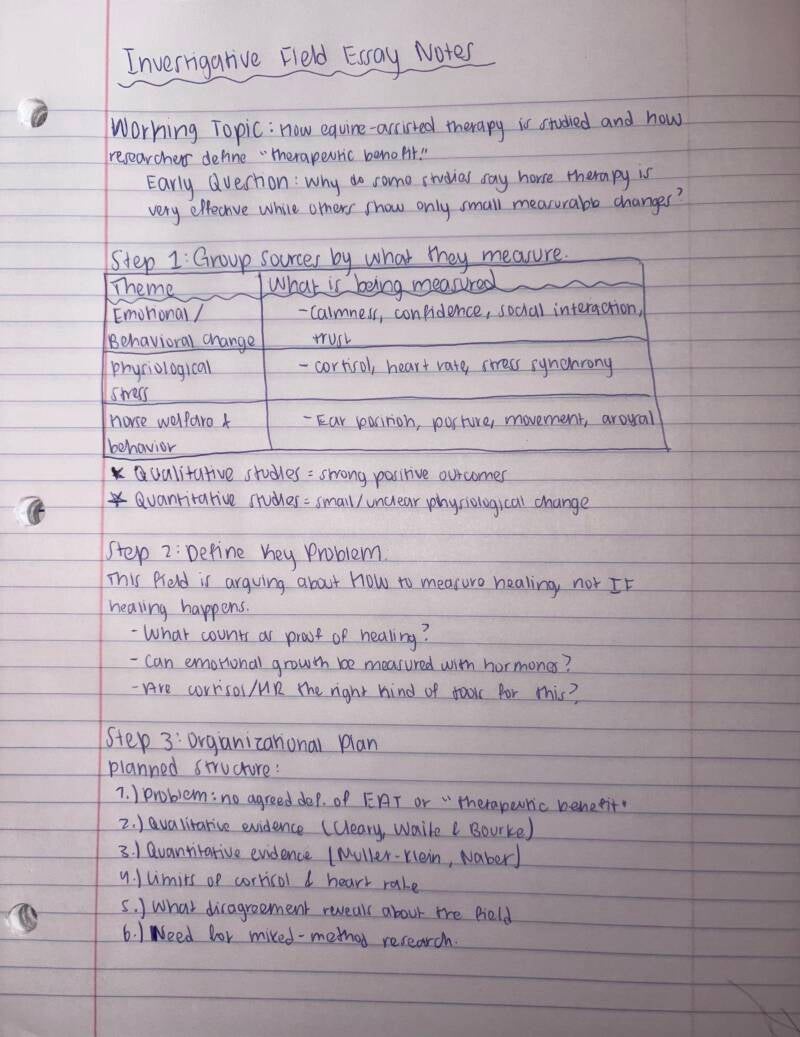
These planning notes show that before drafting, I grouped research by themes and types of evidence rather than by author. This helped me recognize a disagreement in the field about how therapeutic benefit is measured. That realization shaped my thesis and allowed me to organize my essay around ideas instead of summaries of sources.
Artifact 2: Draft to Revision Comparison
Original Draft Paragraph (Before Revision)
The field uses a mix of qualitative and quantitative methods. Qualitative studies like Cleary et al. and Waite and Bourke rely on interviews and observations, which capture how participants experience horse therapy. Reading those studies, you get a sense of individual stories and lived experience. You see how participants describe bonding with a horse or feeling calmer in its presence. The data are analyzed through thematic coding, meaning researchers look for repeated patterns in how people describe their experiences. This method allows depth and detail, but it also relies on interpretation. Quantitative studies like Muller-Klein et al. use experimental designs and physiological data, and Naber et al. measure things like heart rate and cortisol.
Revised Paragraph (After Global Revision)
A major divide in equine-assisted therapy research lies between what qualitative and quantitative studies are designed to notice. Qualitative researchers such as Michelle Cleary et al. and Catherine Waite & Lisa Bourke focus on how participants describe their experiences, capturing emotional bonding, trust, and calmness through interviews and observation. In contrast, quantitative researchers like Alicia Muller-Klein et al. and A. Naber et al. measure stress using cortisol levels and heart rate monitors. This difference is not simply methodological; it determines what counts as evidence. Qualitative studies consistently report meaningful emotional change, while physiological studies report modest biological shifts, suggesting that the tools used to measure stress may not be capturing the same type of benefit participants describe.
What This Revision Shows
In the original paragraph, I mostly described what each study did. In the revised version, I reorganized the paragraph around a central idea, which was the difference in what each method is designed to measure. I added analysis explaining why this difference matters to my argument. This shift from reporting information to interpreting evidence demonstrates my growth in using research rhetorically rather than summarizing it.
Reflective Statement
For my electronic portfolio, I chose to revise my research project on equine-assisted therapy because it is the piece where my growth as a writer is most visible at a global level. When I first drafted this essay, I believed I had done strong academic work because I had gathered credible sources, explained studies carefully, and presented information accurately. What I did not yet understand was that effective academic writing is not measured by how well a writer summarizes research, but by how clearly the writer uses research to make an argument. Revising this project helped me see the difference between reporting information and using evidence rhetorically to guide a reader toward a clear claim.
The most important skill I developed during this course was learning how to perform global revision. Before this class, I thought revision meant fixing wording, grammar, or awkward sentences. Through peer review, instructor feedback, and the structured revision process, I learned that real revision often requires rethinking the entire structure, purpose, and organization of a piece. When I returned to my horse therapy essay, I did not begin by editing sentences. Instead, I asked myself whether the draft actually accomplished what a research argument is supposed to do. I realized that although the paper was informative, it read like a literature review rather than a persuasive academic argument. My paragraphs were organized around individual sources instead of around ideas. As a result, the essay felt like a sequence of summaries rather than a cohesive claim.
This realization led me to completely reorganize the paper. I rewrote my thesis so that it made a clear argument: that the disagreement in equine-assisted therapy research is not about whether the therapy works, but about how therapeutic benefit should be measured. This new thesis required me to restructure every paragraph. Instead of moving from one study to the next, I organized the essay around types of evidence: emotional and behavioral evidence from qualitative studies, physiological evidence from quantitative studies, and the limitations of the tools used to measure stress. This change improved the logical flow of the paper and made it easier for a reader to follow my reasoning.
Through this process, I developed a much stronger understanding of organization as a rhetorical tool. I learned that paragraph order is not accidental. Each paragraph should build toward the thesis and connect clearly to the one before it. I added stronger topic sentences and transitions so that the reader could see how each section contributed to the overall argument. This experience showed me that structure is just as important as content in academic writing.
Another major skill I improved was audience awareness. In my original draft, I wrote as if my reader already understood what equine-assisted therapy was and how research in this field worked. During revision, I added clearer explanations of key terms such as cortisol testing, heart rate monitoring, and thematic coding. I realized that academic writing must guide readers through complex ideas rather than assume prior knowledge. By defining terms and explaining context, I made the essay more accessible and professional.
I also learned how to integrate evidence more effectively. In earlier drafts, I tended to place research into paragraphs without fully explaining how it supported my claim. The studies were present, but their purpose in the argument was not always clear. During revision, I focused on introducing sources with context, explaining why they mattered, and analyzing how they connected to the larger discussion. I learned that evidence should never “sit” in a paragraph on its own. Instead, it should be woven into the writer’s reasoning. This shift from summary to analysis is visible in Artifact 2, where a paragraph that once described studies now explains why their differences matter.
This project also helped me develop a stronger understanding of genre awareness. A research essay is not simply a place to collect information. It is a genre that requires a clear claim, logical development, and purposeful use of evidence. Recognizing this changed how I approached the assignment. I paid attention to how academic writers guide readers through debates, acknowledge complexity, and build arguments step by step. I tried to model this approach in my own writing by making my thesis more explicit and my structure more intentional.
The planning notes shown in Artifact 1 demonstrate how my thinking evolved before and during drafting. I began by grouping sources according to what they measured rather than by author. This allowed me to notice that the disagreement in the field was about evidence and measurement. That observation eventually became my thesis. These notes show that effective writing begins long before the first draft. It begins with organizing ideas and recognizing patterns in research.
Revising this essay also changed how I view the writing process overall. I now understand that writing is recursive. Strong writing develops through cycles of drafting, reflecting, and restructuring. I no longer see revision as a final step but as an essential part of composing. This mindset will be important for me in future academic and professional contexts.
Beyond this course, the skills I developed will be especially important for my future studies and career goals. As someone interested in pursuing medicine, I will frequently read research, write reports, and communicate complex information clearly. The ability to organize ideas logically, write with a clear purpose, and use evidence effectively will be essential in lab reports, research papers, and patient documentation. This project helped me practice those skills in a meaningful way.
I also learned that academic writing involves participating in ongoing conversations. The equine-assisted therapy field is still developing, and researchers disagree about how to measure therapeutic benefit. Instead of trying to resolve that disagreement, my essay analyzes why it exists. This approach reflects a deeper understanding of academic writing as engagement with ideas rather than simple presentation of facts.
Looking back at my original draft, I can see that I had strong content but lacked clear rhetorical direction. Through global revision, I transformed the paper into a cohesive argument. I improved my organization, audience awareness, evidence integration, and understanding of genre. Most importantly, I learned that effective writing requires intentional structure and purposeful use of research.
This project represents my growth as a writer because it shows how I moved from summarizing information to constructing an argument. It also shows how my writing process has become more thoughtful and strategic. The artifacts included in this portfolio demonstrate the planning, drafting, and revision that led to the final version.
Overall, revising my equine-assisted therapy research paper allowed me to apply the key concepts of this course in a practical way. I learned how to revise globally, organize ideas logically, write with audience awareness, and integrate evidence rhetorically. These are skills I will carry with me into future courses and my professional career. Writing is no longer just an assignment to complete, but a tool for thinking, communicating, and engaging with complex ideas.
Create Your Own Website With Webador